
I’ve always loved the idea of colour analysis.
The promise that someone could look at your skin, eyes and hair and tell you exactly which colours would make you glow? Sign me up.
So, when I attended a colour analysis workshop a while ago, I was excited to finally have my season confirmed.
The verdict? Bright Spring.
This was a shock to me and my friends because I wouldn’t describe myself as a particularly “bright” coloured person. Had I really got it so wrong all these years?
I have hazel eyes, my veins lean towards green/blue, my skin is fair and my hair is naturally medium brown. On paper, I tick a lot of the Bright Spring boxes.
The workshop wasn’t a one-on-one consultation. We provided photos beforehand, answered a few questions and then joined a fun group session on the day where we learnt about the 12 seasonal colour palettes. I was sceptical, but my friend told me to trust the process. So over the following months, I decided to lean into it.
I started gravitating towards brighter pieces and even coloured my hair a warm honey blonde because, according to everything I’d learned, that was what should suit a Bright Spring. The strange thing? It never quite felt like me. Nothing looked terrible, but nothing felt effortless either. I kept looking in the mirror thinking, Why doesn’t this look as good as I expected?
For the longest time, I assumed the problem was me. Maybe I just wasn’t styling the colours correctly. Maybe I needed better makeup. Maybe I hadn’t fully committed to the palette.
But recently, while developing my Personal Style System, I decided to do something a little different.
I asked ChatGPT to analyse me.
Now, Before You Roll Your Eyes, Hear Me Out
This wasn’t a quick, “What colour season am I?” question.
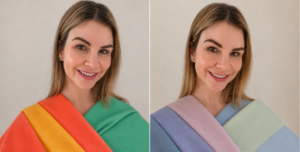
I uploaded multiple photographs taken in different lighting and from different angles, without makeup. The analysis didn’t stop at my eye colour or the tone of my skin. It considered facial contrast, overall harmony, colour intensity, softness versus brightness and how all of my features worked together.
The result surprised me.
Soft Summer.
The more I read through the explanation, the more it made sense. And that’s when I realised something important.
Colour Analysis Isn’t Just About Individual Features
Yes, your hair colour matters. Yes, your skin undertone matters. Yes, your eye colour and even your veins can provide clues.
But they’re only pieces of a much bigger puzzle.
True colour harmony comes from looking at your colouring as a whole. How much contrast exists between your features? Are your colours naturally muted or vivid? Do bright shades enhance your face, or do they wear you? Do warm colours add life, or do softer tones create balance?
Those questions are much harder to answer by looking at one feature in isolation.
And that’s where I think colour analysis can sometimes go wrong. If your obvious characteristics point strongly in one direction, it’s easy to stop there. But humans are far more nuanced than a checklist.
Once I started comparing myself against the Soft Summer palette, everything clicked.
The softer, more muted shades didn’t compete with my features. They complemented them.
The warm honey hair that I’d tried so hard to make work suddenly made sense too. It wasn’t just the warmth that was the issue; it was the brightness. It felt louder than the rest of me.
Looking back through old photographs, I realised I’d often looked my best in colours I’d never have associated with Bright Spring.
Does This Mean ChatGPT Is Better Than a Professional Colour Analyst?
Not necessarily.
There are incredibly talented consultants who take a holistic approach and deliver amazing results. A good colour analyst can look at you in person, see how different colours interact with your skin and make judgements that aren’t always possible from photographs.
But I do think AI offers something genuinely interesting.
It doesn’t get tired. It doesn’t have to make a quick judgement in a setting. It can analyse multiple photographs, revisit its reasoning, compare different possibilities and explain exactly why it reached a conclusion.
For me, the biggest difference wasn’t that AI gave me a different answer.
It was that the explanation finally made sense.
And that’s why I trusted it.
What I Learned
The experience taught me something that goes far beyond colour analysis.
If something doesn’t feel right, it’s okay to question it. It’s okay to get a second opinion. And sometimes, the best answer isn’t the first one you’re given — it’s the one that helps you finally understand yourself.
At Forever Forty, that’s exactly what I’m interested in.
Not chasing trends. Not blindly accepting beauty rules. Just testing ideas, asking questions and sharing what actually works.
Because getting older isn’t about becoming someone else.
It’s about becoming more yourself.
And sometimes, that journey starts with something as simple as wearing a different shade of green.
Want to Find Your Own Colours?
If you’ve ever wondered whether you’ve been wearing the wrong colours, or you’ve had a colour analysis that didn’t quite feel like you, you can try the same kind of AI analysis for yourself.
My Personal Style System takes you beyond simply identifying a colour season. It uses your own photographs to explore your colouring, facial features, body shape and personal style, helping you understand not just which colours suit you, but how to actually use that information when you’re getting dressed.
Because knowing your colours is one thing.
Knowing what to do with them is another.
Disclaimer: This article reflects my personal experience and opinions. Colour analysis isn’t an exact science, and there isn’t always a single “correct” answer. Both professional analysts and AI tools have strengths and limitations, and your results may differ from mine. My goal isn’t to prove that one approach is better than the other, but to encourage curiosity, experimentation and finding what makes you feel your most confident.