
There are certain questions you probably shouldn’t ask AI.
What should I text my ex? Will I ever become financially responsible? And, apparently, how old do I actually look?
But naturally, I asked anyway.
Because once you hit your forties, you become strangely curious about your face. Not necessarily because you think you look old, but because you start noticing things you probably didn’t pay much attention to before. A little more softness here, a few more lines there, and suddenly the under-eye situation seems to require better lighting than the rest of your face.
And then there’s the slightly horrifying experience of seeing yourself on a video call and thinking, Is that what I actually look like?
So I started wondering: if someone who knew absolutely nothing about me saw my face for the first time, how old would they actually guess I was?
Not how old I am. Not how old I feel. And definitely not how old I look after good lighting, makeup, decent hair and finding the one angle that should probably be legally classified as a flattering camera position.
Just…
How old do I look?
And because I’m apparently incapable of leaving a question alone, I decided to ask AI.
I Didn’t Want AI to Flatter Me
I didn’t want to simply upload a selfie and ask, “How old do I look?” That felt a little too much like asking a toddler to review my life choices.
Instead, I created a much more detailed prompt. I wanted AI to look at my face from multiple professional perspectives and, most importantly, not know my actual age.
I specifically told it not to use anything I had previously told it about myself. No age. No birth date. No lifestyle. No medical history. Nothing.
I wanted a completely blind assessment based solely on the photographs. Because if AI knows I’m 42 before it starts analysing my face, how do I know it isn’t simply working backwards?
I also didn’t want one vague number. I wanted to know why I look the age I look.
Is it my skin? My eyes? My facial structure? My jawline? My hair? My makeup? And, perhaps more importantly, what are the things making me look younger?
Because those are two very different questions.
So I basically assembled an imaginary panel of experts: a dermatologist, an aesthetic physician, a facial plastic surgeon, an oculoplastic specialist, a facial aesthetics specialist, a makeup artist, a hairstylist, a portrait photographer and an age-perception researcher.
Possibly the most overqualified panel ever assembled to stare at someone’s face.
And then I told them all to be brutally honest.
Here Is the Exact Prompt You Can Use
If you want to try this yourself, you can copy and paste the prompt below into ChatGPT. All the text in green is the prompt. Upload your photographs first, paste the prompt and let it complete the blind assessment before revealing your age. For the most useful result, use several photographs rather than one carefully curated selfie. Ideally, include:
- Front-facing, neutral expression
- Front-facing, smiling
- Left 45-degree angle
- Right 45-degree angle
- Side profile
- Natural daylight photograph without makeup, if available
And don’t use filters. Unless you need an ego boost, in which case… carry on. This is supposed to be fun.
AI Multidisciplinary Visual Age Assessment Prompt:
You are going to perform a rigorous visual age estimation assessment based ONLY on the photographs I provide. Do not use my stated age, birth date, medical history, lifestyle, occupation, ethnicity, or any other personal information I may have previously given you. Treat this as a blind assessment. Your task is NOT to flatter me. Give me your most honest, evidence-based estimate of the age I visually appear to be.
EXPERT PANEL
Approach the assessment as if you are consulting a multidisciplinary panel consisting of:
- Board-certified dermatologist: Assess visible signs of chronological and photoageing. Examine fine lines, wrinkles, pigmentation, sun damage, skin texture, elasticity, laxity, pore appearance and overall skin quality.
- Aesthetic physician: Assess facial ageing patterns. Examine volume distribution, tissue descent, facial proportions, jawline definition, cheek structure, under-eye area and lower-face ageing.
- Facial plastic surgeon: Evaluate structural indicators of facial ageing.
- Consider skin laxity, midface descent, jowling, nasolabial folds, marionette area, neck appearance and preservation of youthful facial architecture.
- Oculoplastic specialist: Assess the eye region separately. Examine eyelid skin, under-eye hollows, tear troughs, puffiness, crow’s feet, brow position and perceived eye-area age.
- Dermatologic cosmetic specialist: Assess complexion quality, pigmentation, redness, texture, luminosity and visible cumulative environmental exposure.
- Facial anthropometry / facial aesthetics specialist: Examine proportions, symmetry, facial thirds, cheek-to-jaw relationship, facial contours and other structural characteristics that influence perceived age.
- Professional makeup artist: Evaluate how makeup, brows, lashes and complexion products influence perceived age. Separate actual facial characteristics from makeup-created effects.
- Professional hairstylist / image consultant: Assess how hairstyle, colour, volume, hairline and styling influence perceived age. Do not allow hairstyle alone to determine the final estimate.
- Professional portrait photographer: Account for lighting, lens distortion, camera angle, facial expression, image quality and photographic conditions. Identify anything that may artificially make me look older or younger.
- Age-perception researcher: Consider the overall combination of facial cues that humans typically use when estimating someone’s age.
IMPORTANT RULES
- Do not anchor to my actual age. You must NOT begin with my known age and work backwards. Pretend you have never been told my age.
- Separate the different concepts of age. Give me separate estimates for:
- Overall perceived age
- Skin age
- Facial structural age
- Eye-area age
- Lower-face/jaw/neck age
- Overall “youthfulness” score
- Overall “maturity” score
- These are not necessarily the same.
- Give a range, not false precision
- First provide your estimated age range.
- Then provide your single best estimate.
- For example:
- Estimated apparent age: 38–42
- Best estimate: 40
- Do not pretend you can determine my exact chronological age from a photograph.
- Analyse evidence, not stereotypes
- Do not use stereotypes based on gender, ethnicity, clothing, attractiveness, body shape or fashion.
- Focus on observable visual characteristics.
- Distinguish real ageing cues from temporary factors
- Identify whether each observation is likely related to:
- chronological ageing
- photoageing
- genetics/facial structure
- temporary expression
- dehydration
- lighting
- makeup
- hairstyle
- camera angle
- image quality
FACIAL AGE ANALYSIS
Analyse the following individually:
- Forehead
- Fine lines
- Dynamic lines
- Skin texture
- Smoothness
- Overall perceived age
- Brow area
- Brow position
- Brow shape
- Upper eyelid exposure
- Brow/eye relationship
- Eyes
- Crow’s feet
- Under-eye skin
- Tear trough
- Hollowness
- Puffiness
- Darkness
- Eyelid laxity
- Overall eye-area age
- Midface
- Cheek volume
- Skin firmness
- Nasolabial folds
- Midface descent
- Facial fullness
- Nose / central face
- Proportions
- Skin quality
- Relationship to surrounding facial structures
- Lower face
- Jawline definition
- Jowling
- Marionette lines
- Chin definition
- Lower-face volume distribution
- Neck
- Skin quality
- Horizontal lines
- Laxity
- Definition
- Transition between jaw and neck
- Skin
- Assess:
- fine lines
- wrinkles
- pigmentation
- sun spots
- redness
- pore visibility
- texture
- elasticity
- firmness
- luminosity
- hydration appearance
- overall skin quality
FACIAL STRUCTURE
Assess whether my facial structure appears:
- youthful
- mature
- neutral
- unusually youthful
- unusually mature
- Explain why.
- Pay particular attention to:
- cheek projection
- facial fullness
- jaw definition
- chin
- facial thirds
- facial symmetry
- soft-tissue distribution
- midface proportions
- lower-face proportions
OVERALL PERCEPTION
After analysing individual features, step back and assess the face as a whole. Ask: “If I saw this person briefly in real life and had to guess their age, what age would I instinctively guess?” This should be based on the combined visual impression rather than simply adding up wrinkles.
AGE ESTIMATE
Give me:
- Estimated apparent age range:
- Single best estimate:
- Confidence level: Low / Moderate / High
- How many years younger or older I appear than my actual age — ONLY if my actual age is independently provided after your blind assessment.
WHAT MAKES ME LOOK YOUNGER?
Identify the 5 strongest visual factors contributing to a younger perceived age. Rank them from strongest to weakest.
WHAT MAKES ME LOOK OLDER?
Identify the 5 strongest visual factors contributing to an older perceived age. Rank them from strongest to weakest. Be honest. Do not manufacture negative observations simply to appear objective.
BIGGEST AGEING CUES
Tell me the 3 features that have the greatest influence on my apparent age. For each one explain:
- what you see
- how strongly it influences perceived age
- whether it is primarily structural, skin-related, temporary or styling-related
- whether it is something that can realistically be improved
BIGGEST YOUTHFUL CUES
Tell me the 3 features that most strongly make me look younger.
FINAL VERDICT
End with a concise assessment:
“If I had to guess this woman’s age without knowing anything about her, I would guess ___ years old.” Then give me a brutally honest but constructive explanation of why.
PHOTO REQUIREMENTS
If the photographs are inadequate for a reliable assessment, tell me exactly what is missing before giving me a final estimate. Ideally analyse:
- Front-facing neutral expression
- Front-facing smiling
- Left 45-degree angle
- Right 45-degree angle
- Side profile
- Natural daylight photograph without makeup if available
Do NOT give me a more confident estimate than the photographs justify. Remember: the objective is not to tell me how old I want to look. The objective is to estimate how old I actually LOOK.
——————– PROMPT END ——————–
Then Comes the Moment of Truth
Once you’ve uploaded your photographs and run the prompt, AI should give you a proper breakdown rather than simply throwing out a number. And this is where I think it gets really interesting. Imagine it comes back and says:
Overall perceived age: 39–43
Best estimate: 41
Okay. Interesting.
But then it tells you that your skin reads younger than your overall facial structure. Your eye area is adding a couple of years. Your cheek volume is one of your strongest youthful features. Your jawline is still relatively defined. And pigmentation is contributing more to your perceived age than your actual wrinkles.
Suddenly, you’ve learned something. You haven’t just been given a number. You’ve been given a map. And that’s much more useful.
Don’t Immediately Panic If AI Says Something You Don’t Like
This is important: a perceived age assessment isn’t a beauty score. And it definitely isn’t a measurement of how attractive you are. You can look older than your chronological age and still look absolutely fantastic. You can look younger and still hate your face that day. And you can have one feature that reads as more mature while the rest of your face reads significantly younger. That’s why I like the idea of looking at the individual components rather than obsessing over the final number.
Because ageing isn’t a pass-or-fail exam. There isn’t a magical age where you’ve suddenly failed. We’re all just collecting facial character as we go. Some of us are collecting it faster than others.
What If You Want an Actual Report?
The prompt above will give you a detailed text assessment directly in ChatGPT, which is great if you’re simply curious about what AI sees when it looks at your face. But if you want to go a little deeper, I’ve created something that takes this idea much further.
My AI Beauty System is a collection of personalised AI analysis prompts designed to turn all of that information into beautifully structured, report-style assessments. Instead of having to scroll through a very long ChatGPT conversation trying to find the useful bits, you get individual reports that break down different aspects of your appearance and give you practical ideas for what you can actually do with the information.
The system covers:
- Skin Quality Report — Understand what your skin is doing well, what may be contributing to visible ageing and where you could focus your skincare efforts.
- Facial Harmony Report — Explore your facial proportions, balance and harmony, along with personalised optimisation options.
- Facial Age Profile — Find out which features are contributing to your perceived age, what’s making you look younger and where your biggest ageing cues are.
- Hairstyle & Styling Report — Discover hairstyles and styling approaches that work with your facial features and overall appearance.
- Hair Colour & Cut Report — Explore the hair colours and cuts that are most likely to complement your colouring, features and personal style.
- Eyebrow Analysis — Look at your brow shape, structure and placement, and how small changes could influence the overall balance of your face.
- Makeup Analysis — Get personalised guidance on makeup placement, colours and techniques that work with your individual features rather than following generic makeup rules.
- Complete Glow-Up Planner — Bring everything together into a personalised plan, so you’re not just collecting information about your face but actually have a roadmap for what to do next.
The idea isn’t to tell you that you need to fix everything. Quite the opposite. It’s about understanding what you already have, what is working in your favour and where a few strategic changes could make the biggest difference. Because at 40+, I’m much more interested in looking like the best version of myself than trying to look like someone I’m not.
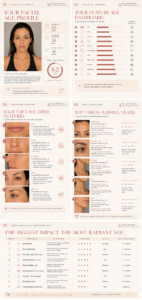
You can find the AI Beauty System here.