The smoothie that brings the protein, the antioxidants and a little bit of “I’m trying to age backwards” energy.
There are smoothies that are basically fruit salad in a glass, smoothies that taste like lawn clippings, and then there are smoothies that actually have a job to do. This one is firmly in the third category.
My Anti-Ageing Collagen Smoothie combines blueberries, strawberries, golden kiwi, collagen and protein powder into one ridiculously pretty glass of goodness. It is fruity, creamy without actually containing any cream, naturally sweet and packed with ingredients I particularly like having in my diet now that I am firmly in my Forever Forty era.
And while no smoothie is going to stop the clock – and if anyone discovers one, please send it directly to my inbox – there is something to be said for filling your diet with foods that provide antioxidants, vitamin C and protein.
And, as it turns out, there is some pretty interesting science behind why these particular ingredients make such a good team.
Meet the golden kiwi: the underrated little anti-ageing overachiever
The golden kiwi might not have quite the celebrity status of the blueberry, but I think it deserves its moment in the spotlight. Especially now.
New research from the University of Otago has given us a particularly interesting reason to pay attention to this little golden fruit. In a 2026 study published in the Journal of Investigative Dermatology, researchers looked at what actually happens to vitamin C in the skin when we increase our dietary intake.
And this wasn’t a “we asked people what they ate and filled in a questionnaire” kind of study.
The researchers first established the relationship between vitamin C levels in the blood and different layers of human skin. They then conducted an eight-week dietary intervention involving 24 healthy adults in New Zealand and Germany. Participants ate two SunGold kiwifruit every day, providing approximately 250 mg of vitamin C daily.
The results were fascinating.
Increasing dietary vitamin C increased vitamin C levels in the skin, and the researchers observed a significant increase in skin thickness, which they interpreted as reflecting increased collagen production. They also found an increase in the regeneration of epidermal cells – in other words, the outer layer of the skin was renewing itself more actively.
Even more interestingly, the researchers found a strong relationship between vitamin C levels in the bloodstream and vitamin C levels throughout the skin.
That is rather lovely news for those of us who have spent years slathering vitamin C serum on our faces while occasionally forgetting that our skin is attached to the rest of us.
The study is particularly interesting because it provides human evidence that vitamin C consumed through food can reach the skin and is associated with measurable changes in skin structure and renewal.
Now, before we get carried away and start calling the golden kiwi the fountain of youth, there are a couple of important caveats. This was a relatively small study, and the researchers studied SunGold kiwifruit specifically because of its high and consistent vitamin C content. The study also wasn’t designed to prove that eating kiwi prevents wrinkles or makes you look younger. But the findings are certainly interesting.
And they fit rather nicely with what we already know about vitamin C and collagen – which we’ll get to in a minute.
There is also older laboratory research looking specifically at gold kiwifruit and ageing-related processes. Researchers have found antioxidant and anti-glycation activity in extracts of Actinidia chinensis, the species that includes gold kiwifruit. Glycation is particularly interesting in the ageing conversation because advanced glycation end products can accumulate in proteins such as collagen and are associated with changes in tissue structure and skin ageing.
Important little scientific disclaimer: that particular research was conducted using fruit extracts and laboratory models, not women drinking smoothies while trying to remember where they left their reading glasses. So I’m definitely not claiming that golden kiwi prevents wrinkles.
I am saying that this bright little fruit is exceptionally rich in vitamin C, brings antioxidant compounds to the party and now has some rather intriguing human research behind it.
And I’m considerably happier eating it than staring at a laboratory petri dish.
Blueberries: basically the OG of the superfood world
If fruit had celebrity status, blueberries would absolutely be front row.
They have the colour. They have the reputation. They have the research.
Blueberries have earned their superfood status largely because they are rich in polyphenols, particularly a group of compounds called anthocyanins. These are responsible for that gorgeous deep blue-purple colour – and they’re also one of the reasons blueberries have attracted so much scientific attention.
A systematic review of 45 human intervention studies found that blueberries may have beneficial effects on markers of vascular function, although the researchers also pointed out that results for inflammation, oxidative stress and some cardiometabolic markers were less consistent.
More recent research continues to make anthocyanins particularly interesting. A 2024 systematic review of randomised controlled trials found evidence of positive effects of anthocyanin intake on cognition, including verbal and working memory, while findings around blood pressure and endothelial function were more mixed.
And a 2026 systematic review and meta-analysis looking at dietary anthocyanins found associations between higher habitual intake and lower cardiovascular disease and myocardial infarction risk in prospective cohort studies, while randomised trials found improvements in measures of vascular function.
So, yes, the humble blueberry has rather a lot going for it. But I don’t want to turn it into a magical purple medicine either.
“Superfood” isn’t a scientific classification. It’s a wonderfully useful bit of marketing shorthand for foods that are particularly nutrient-dense or rich in bioactive compounds. And blueberries certainly fit the bill.
What I particularly love is that you don’t need to eat them in some elaborate wellness bowl decorated with edible flowers and a tiny spoon of something you’ve never heard of.
You can literally buy a bag of frozen blueberries, throw them into a blender and get all that lovely fruit, fibre and those polyphenol-rich anthocyanins in one very easy breakfast.
And because we’re using a whole cup of them here, they’re not just there to make the smoothie look like something you’d find on the menu at a very expensive wellness retreat. They’re doing some of the heavy lifting.
Vitamin C and collagen: this is where things get really interesting
This is the bit I really wanted to understand when I created this smoothie.
Because if we’re going to call something an Anti-Ageing Collagen Smoothie, I want there to be more behind the name than a pretty glass and some wishful thinking.
Collagen is the main structural protein in our skin and connective tissues. It provides strength and structure, and our ability to maintain collagen changes as we age.
But here’s the important bit: your body needs vitamin C to make collagen properly.
Vitamin C acts as a cofactor for enzymes called prolyl and lysyl hydroxylases, which are essential during collagen formation. These enzymes help modify the collagen molecules so they can form the stable structure your body needs. Without adequate vitamin C, this process is impaired.
In other words, vitamin C isn’t just sitting beside collagen looking supportive. It is actually involved in the construction process.
Research in human skin fibroblasts has also shown that vitamin C can stimulate collagen synthesis and influence the expression of genes involved in producing procollagen – the precursor to mature collagen.
And a review of the evidence on vitamin C and skin health describes two particularly important roles: supporting collagen synthesis and providing antioxidant protection against oxidative damage.
Which brings us neatly back to this smoothie.
Because I haven’t just thrown a scoop of collagen into a blender and hoped for the best. I’ve surrounded it with vitamin-C-rich fruit.
The golden kiwi and strawberries provide vitamin C, while the blueberries bring their impressive collection of polyphenols and anthocyanins.
And now that new kiwifruit research has shown that increasing dietary vitamin C can increase vitamin C levels in the skin and is associated with increased skin thickness and epidermal renewal, the combination feels even more interesting.
I should stress that the study did not test this particular smoothie, and it did not prove that adding collagen powder to vitamin-C-rich fruit produces a bigger anti-ageing effect. But biologically, the pairing makes sense.
Think of it as giving your collagen its supporting cast. Because even collagen deserves a good team.
Why I added protein too
The collagen gives this smoothie its beauty-from-the-inside-out angle, but I also wanted it to actually keep me going.
That’s where the protein powder comes in.
If you’re trying to eat more protein, maintain muscle or simply make your breakfast or snack more satisfying, adding a scoop of protein powder is an easy way to increase the protein content without turning your smoothie into a 14-ingredient production.
And honestly, this matters more to me now than it used to.
As we get older, maintaining muscle becomes increasingly important, which means getting enough protein isn’t just about gym-bros and protein shakers anymore.
So yes, I’m interested in collagen. I’m interested in antioxidants. I’m interested in vitamin C. But I’m also interested in keeping the muscle I’ve worked rather hard for.
The combination of fruit, protein and collagen makes this a much more substantial option than simply blending up fruit and calling it breakfast.
The result? A very pretty glass of self-care
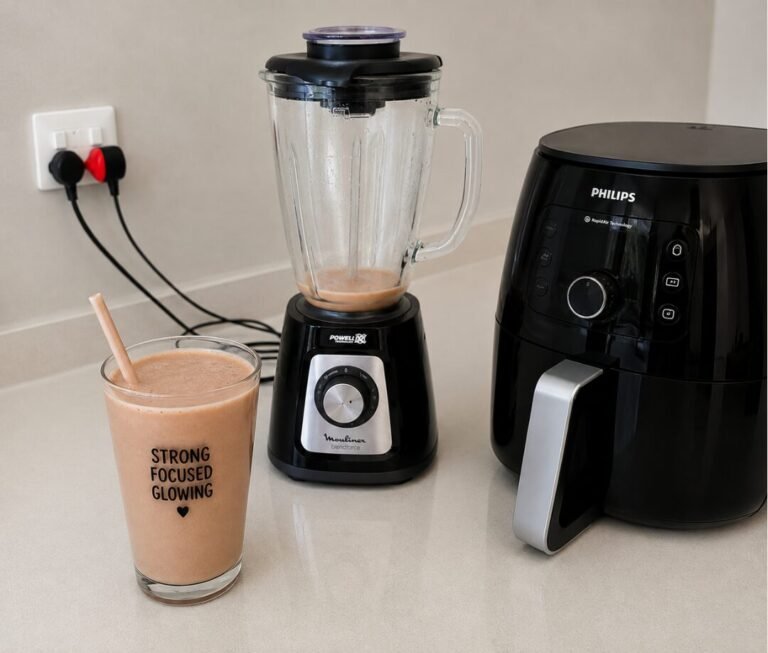
The finished protein shake is sweet, fruity and creamy, with the blueberries giving it that beautiful deep-purple colour and the strawberries adding even more freshness.
The golden kiwi brings a slightly tropical, tangy sweetness that stops the whole thing from tasting like a blueberry milkshake.
And because we’re using frozen fruit, you don’t need ice. Which means there is one less thing for your blender to complain about.
Just add everything to your blender, whizz until smooth and drink immediately.
I like mine thick and cold, but if you prefer a thinner smoothie, simply add a little more water.
And that’s it.
Just fruit, protein, collagen, vitamin C, some water and a blender.
A very simple way to put a little more goodness into your day – and perhaps give your future self something to thank you for.
Why you’ll love this smoothie
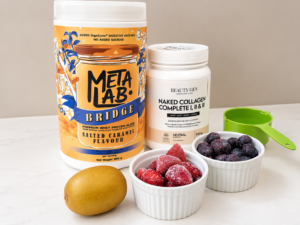
It’s high in protein, packed with antioxidant-rich fruit, naturally sweet, rich in vitamin C and incredibly easy to make.
It also gives you a rather lovely combination of ingredients: collagen, protein, vitamin C and polyphenol-rich berries, all in one glass.
And, perhaps most importantly, it tastes like something you’d actually want to drink. Because healthy food doesn’t have to taste like punishment.
Now that’s my kind of self-care.
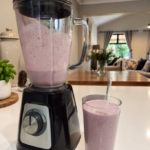
My Anti-Ageing Collagen Smoothie: High in Protein, Vitamin C & Antioxidants
Ingredients
- 1 cup frozen blueberries
- 1 cup frozen strawberries
- 1 golden kiwi fruit peeled
- 1 scoop collagen powder
- 1 scoop protein powder
- 250 ml water
Instructions
- Add all the ingredients to a blender and blend until completely smooth.
- Pour into a glass and enjoy immediately.
Frequently Asked Questions
Is this smoothie really anti-ageing?
Not in the sense that it can stop or reverse ageing – and sadly, I haven’t discovered the secret to that yet. The “anti-ageing” nickname comes from the combination of ingredients that support healthy ageing, including vitamin C, antioxidant-rich berries, protein and collagen. Vitamin C is essential for normal collagen production, while the fruit provides a variety of antioxidant compounds. Think of it as supporting your body as you age, rather than trying to outrun the clock.
Why is vitamin C important for collagen?
Vitamin C is essential for collagen synthesis. Your body uses vitamin C as a cofactor for enzymes involved in building and stabilising collagen. Without enough vitamin C, normal collagen formation is impaired. That’s why pairing a collagen supplement with vitamin-C-rich foods such as golden kiwi and strawberries makes nutritional sense.
Does golden kiwi help with skin ageing?
Golden kiwi is naturally very high in vitamin C, and new human research has made it particularly interesting from a skin-health perspective. An eight-week study found that eating two SunGold kiwifruit daily increased vitamin C levels in the skin and was associated with increased skin thickness and epidermal cell regeneration. It’s promising research, but it doesn’t mean golden kiwi has been proven to prevent wrinkles or reverse skin ageing.
Why use golden kiwi instead of green kiwi?
Both are nutritious, but golden kiwi is particularly useful in this smoothie because it provides a substantial amount of vitamin C while being naturally sweet and less tart than green kiwi. It also gives the smoothie a lovely tropical note without needing added sugar.
Why are blueberries considered a superfood?
“Superfood” isn’t a formal scientific category, but blueberries have certainly earned the reputation. They’re rich in polyphenols, particularly anthocyanins, the compounds responsible for their deep blue-purple colour. Research has investigated blueberries and anthocyanins for their potential effects on cardiovascular health, vascular function and cognitive health, among other areas.
Can I use fresh blueberries and strawberries instead of frozen?
You can, but frozen fruit makes the smoothie thick. If you’re using fresh fruit, you can add a few ice cubes if you still want that thick, smoothie texture.
Can I use a different protein powder?
Yes. Use whichever protein powder you enjoy and tolerate well. Whey, plant-based or other protein powders can all work. Just remember that the amount of protein in the finished smoothie will depend on the specific powder you use, so check the nutrition label on your product.
Can I leave out the collagen powder?
You can, but then it becomes a very good antioxidant protein smoothie rather than a collagen smoothie. Plus the collagen adds so much creaminess to this smoothie.
Does collagen powder contain vitamin C?
Not necessarily. Some collagen supplements contain added vitamin C, while others don’t. Check the label of your particular product rather than assuming. In this recipe, you’re getting vitamin C naturally from the fruit regardless.
Can I drink this smoothie every day?
For most healthy adults, this can be a perfectly reasonable smoothie to include regularly as part of a varied diet. However, you don’t need to drink it every day to benefit from eating fruit, getting enough protein or including vitamin-C-rich foods. Variety is still a very good thing.
Is this smoothie good for weight loss?
It can certainly fit into a weight-loss diet, but no individual smoothie causes weight loss. What matters most is your overall calorie intake, diet quality, protein intake, activity and consistency over time. Because this smoothie contains fruit and protein, it can make a more satisfying breakfast or snack than a smoothie made almost entirely from fruit or juice.
How much protein is in the smoothie?
There is about 37g of protein however, that number depends on the protein and collagen powders you use. Protein powders vary considerably, so the most accurate way to calculate the total is to add the protein listed on your particular labels to the protein naturally provided by the fruit.
Can I make this smoothie ahead of time?
It’s best enjoyed soon after blending, particularly because vitamin C can gradually degrade with exposure to oxygen and light. Plus, it starts to froth up at the top, which isn’t bad, I just prefer it thick.
What makes this a good smoothie for women over 40?
For me, it’s the combination rather than one miracle ingredient. As we get older, I’m increasingly interested in protein for maintaining muscle, vitamin C for collagen synthesis, and a diet rich in colourful plant foods and their antioxidant compounds. This smoothie manages to bring all of those things together in something that actually tastes good. And frankly, if I’m going to drink something that is supposed to support my future self, I want it to taste like strawberries and blueberries – not punishment in a glass.